I love my local library. As a reader, of course I love it! Nowadays it has taken on a fresh new look. Comfortable easy chairs in a sleek art deco style, bright colors, indoor "patio" tables with bright colored umbrellas, a huge teepee, interesting displays, a full-sized plastic skeleton, "trader" paperbacks free for the taking, a wonderful dollhouse for my granddaughter to populate with her choice of toy people, dinosaurs, furniture, and a tiger (her favorite), plus the usual assortment of books, etc. For the past two years or so, I have been using the Library2Go Oregon Digital Library Consortium service too. This comes free with my library card.
I especially like to download audio books that I can listen to as I go about my daily routine. Usually I listen to British mysteries, you know, stories set in "peaceful" country villages where nothing ever happens. Ha!
I like writers such as P.D. James, Dorothy L. Sayers, Ngaio Marsh, M.C. Beaton, Agatha Christie, Elizabeth George and Deborah Crombie. The last two are American writers whose stories are set in Great Britain. There are many more I could list. Besides mysteries set in Great Britain, I also like to listen to Donna Leon's Detective Brunetti mysteries. These are set in Venice so I get a vicarious visit to that magical city with each new story.
And, I like Andrea Camilleri's Inspector Montalbano series, set in Sicily, so more vicarious travel.
One caveat with my choice of mystery books. I do not like realistic detective fiction. Spare me the autopsies, and psychopaths who build snowmen in the yards of their victims, or put body parts in the car boot. No thanks. Some of my writers throw in gruesome scenes but one is not taken into the mind of the killer. Elizabeth George is an exception, I guess. My "cosy" mysteries, where there IS murder, it is (for the most part) sanitized such that my delicate sensibilities can handle it.
So far in 2016, I have listened to sixteen audio books. They are not all mysteries. I have "read" Rosamunde Pilcher, Emile Zola, Anthony Trollope, and listened to an Arthur Miller play. OK, I'm a dreamer but isn't reading an escape, no matter how it is accomplished? At least with audio books, I get my chores finished!
And, a trip to the library is as easy as picking up my iPod. However, these days, I am making more trips in person to my local library. Sitting in a teepee is fun!
Do you listen to audio books? What have you "read" lately?
Thursday, March 17, 2016
Saturday, March 12, 2016
Truth and Vipers
"There are many ways to the recognition of truth, and Burgundy is one of them." -- Isak Dinesan
Earlier today I pulled some books off the bottom shelf of my study bookcase. I had decided it was time to add more books to LibraryThing and these had been lurking in a dusty corner for far too long. As you see, there is a theme:

Back in the day, we were avid home wine makers (and drinkers!). We planted twenty pinot noir (Burgundy) vines in the backyard and took several wine making and tasting classes. It was so fun! We made our own wine for a few years. It was so-so, and eventually we moved on. But one of the best things we did was travel to France. We used "Adventures on the Wine Route" by Berkeley wine importer, Kermit Lynch, as our guide through French wine country. We had many of our own adventures and have never even once been sorry we made the trip.
We traveled by train from Paris to Dijon. In Dijon we picked up a rental car and spent the next two weeks driving around Burgundy, Provence, the Languedoc, and Bordeaux. Here are few pictures of Burgundy:
Wine "growler" shop in Gamay
Burgundy Scenes
The center photo was taken near Savigny-les-Beaune. We were there looking for a particular vineyard, "Les Serpentiers". We were never sure, but hoped this picture was the vineyard. According to the wine making brothers Pichenot, Kermit Lynch tells us in "Adventures on the Wine Route":
"Having always loved the vineyard name, "Les Serpentiers", which goes back to at least the thirteenth century, I ask if they know its origin.
Tuesday, March 1, 2016
A Horde of Rebels
"...reading, you know, is rather like opening the door to a horde of rebels who swarm out attacking one in twenty places at once..." -- Virginia Woolf
It is past time for an update on where we have been and where we are going on the Road Map journey. I have had the "rebels" on my tail for the past few weeks and I am glad to report they are harmless, and in fact, quite enlightening and entertaining.
Firstly, I can tick two of my 2016 To Be Read books off the list:
Millions of words have been written about Virginia Woolf, one of the early 20th century's vanguard novelists. She helped to bring the stream of consciousness style into being and because of this, her work is considered difficult. The Virginia Woolf Reader is like a See's Candy Christmas box. We get to taste bits from here and there, every one wrapped in bright foil paper with plenty of bows. Editor Mitchell Leaska chose well. There are bits from essays, novels, short stories, diaries, and letters. I did not read the diaries section because of this:
I really do not like to read extracts from diaries. I want the whole life story, as written by the diarist. This is Volume One of the definitive 4-volume set edited by Anne Bell with an introduction by her husband, Quentin Bell. Quentin is Virginia's nephew, son of her artist sister Vanessa. Quentin wrote this excellent biography:
Many years ago, I read To the Lighthouse and Mrs. Dalloway, two of VW's most well-known works. I then read this biography and have been a "fan" (aka "Bloomsberry") ever since. Much more to come about Bloomsbury at a later date. VW lived in a time of great upheaval. She experienced the pain of loss at an early age and suffered from intermittent mental and emotional instability. This instability led to VW's suicide by drowning in 1941. Speculation has ranged from bi polar to schizophrenia. In the early 20th century, her malady was called "insanity". She was fortunate to have been born into the upper middle class or she might have spent her life in an asylum. Instead, she was cared for in hospitals and at home with private nurses. She was lucid most of the time and was a founding member of the Bloomsbury Group, the famous set of authors, artists, intellectuals, and hangers-on who lived or met in the Bloomsbury area of London in the early years of the 20th century. Her life was rich, her writing was sublime, and I encourage you to investigate VW. Do not be "afraid".
In the 1920's, Virginia began a mild love affair with Vita Sackville-West. Vita was an aristocrat. Her family, the Sackvilles, have lived at Knole, one of England's largest country houses, since 1603. The vast estate was given to Vita's ancestor, Thomas Sackville by his cousin Queen Elizabeth I in 1566. The house dates to the late 15th century, with many additions over time. Vita became a celebrity in England in the early 20th century because of two famous court cases. In the first, Vita's mother was proven to be the legal heir to her father Lord Sackville (there was a question as to whether Lord Sackville ever married the Spanish dancer, "Pepita", Vita's grandmother). In the second, Vita's mother was proven to be entitled to a bequest made to her by one of her admirers. The English public was enamoured with Vita, the beautiful young heiress, and could not get enough of her and her family's public humiliation followed by triumph in the courts.
Vita was also a prolific writer. Her best known work these days is the novel, All Passion Spent. She married the diplomat, Harold Nicolson, at Knole in 1913. They were both bi-sexual and each had love affairs with both sexes. Vita and Virginia's affair was mild, mostly a meeting of great minds, as Vita was aware of Virginia's fragile emotional state, and did not want to harm her in any way.
In Portrait of a Marriage, Nigel Nicolson, Vita's son, presents us with a view of the unusual marital arrangement between his parents, Harold and Vita. Theirs was an unbreakable love, a bond strong enough to withstand the emotional turmoil of passionate love affairs. By agreement, they gave each other the room to live their own separate lives, knowing they were each other's ROCK.
The book is divided into parts written by Vita and by Nigel, as well as excerpts of letters written by Vita and Harold. Vita had written an autobiography but locked it away in her tower writing room, unseen by anyone until after her death in 1962. Her son Nigel includes Vita's autobiography and his wider-view version of the same events Vita writes about. Most of the book is taken up with the drama around Vita's passionate love affair with Violet Keppel, which lasted over two years. Vita and Violet wanted to live together but had to run away from England to do so. This planned arrangement created turmoil and tremendous upheaval for everyone involved. Finally, getting as far as France, they break up and Vita returns to her family and begins a much quieter life of seclusion in the Kentish countryside. She and Violet were to meet and travel together a few more times, but the affair gradually wound down.
Vita and Harold had two sons, and created one of England's great tourist attractions: the gardens at Sissinghurst castle, their family home. Now owned by the National Trust, Sissinghurst was a refuge and the gardens their major project after the stormy first years of their marriage. As a female, Vita could not inherit Knole due to the laws of primogeniture. She mourned the loss of her family home to a male cousin. Virginia Woolf was aware of Vita's great sadness over the loss of Knole. She penned Orlando, her well-known novel of gender bending and time travel with Vita and Knole as her inspiration. I am currently reading Orlando and will give you my thoughts on it at a later date.
Finally, Portrait of a Marriage is a lasting tribute to a great love. The love of a man and woman for each other -- come what may. To most, it seems scandalous and a bit naughty that they were tolerant of each other's affairs, and they even refer to this perceived naughtiness in their letters to one another (Harold, as a diplomat, traveled extensively). In their view it was not naughty, rather a mature and generous agreement to allow each other the freedom to live, really live, their own one life in this world.
Referring to Vita's feelings for Virginia and for the effects on her husband Leonard, Harold says in his 2 December 1926 letter to Vita:
"I am far more worried for Virginia's and Leonard's sake than for ours. I know that for each of us the other is the magnetic north, and that though the needle may flicker and even get stuck at the other points, it will come back to the pole sooner or later."
Quite civilized, I must say.
Reading update:
Listened to two cosy mysteries using my library's digital download feature.
Read my cousin's first novel, The Wish and the Waterfall. Quite the good book, and a post on it to come at a later date. Way to go, Ken!
Currently reading A Pilgrim at Tinker's Creek, also on the 2016 TBR challenge and Orlando by Virginia Woolf.
I think that is it for now. I am not worried about the hordes! Ciao!
It is past time for an update on where we have been and where we are going on the Road Map journey. I have had the "rebels" on my tail for the past few weeks and I am glad to report they are harmless, and in fact, quite enlightening and entertaining.
Firstly, I can tick two of my 2016 To Be Read books off the list:
Millions of words have been written about Virginia Woolf, one of the early 20th century's vanguard novelists. She helped to bring the stream of consciousness style into being and because of this, her work is considered difficult. The Virginia Woolf Reader is like a See's Candy Christmas box. We get to taste bits from here and there, every one wrapped in bright foil paper with plenty of bows. Editor Mitchell Leaska chose well. There are bits from essays, novels, short stories, diaries, and letters. I did not read the diaries section because of this:
I really do not like to read extracts from diaries. I want the whole life story, as written by the diarist. This is Volume One of the definitive 4-volume set edited by Anne Bell with an introduction by her husband, Quentin Bell. Quentin is Virginia's nephew, son of her artist sister Vanessa. Quentin wrote this excellent biography:
Many years ago, I read To the Lighthouse and Mrs. Dalloway, two of VW's most well-known works. I then read this biography and have been a "fan" (aka "Bloomsberry") ever since. Much more to come about Bloomsbury at a later date. VW lived in a time of great upheaval. She experienced the pain of loss at an early age and suffered from intermittent mental and emotional instability. This instability led to VW's suicide by drowning in 1941. Speculation has ranged from bi polar to schizophrenia. In the early 20th century, her malady was called "insanity". She was fortunate to have been born into the upper middle class or she might have spent her life in an asylum. Instead, she was cared for in hospitals and at home with private nurses. She was lucid most of the time and was a founding member of the Bloomsbury Group, the famous set of authors, artists, intellectuals, and hangers-on who lived or met in the Bloomsbury area of London in the early years of the 20th century. Her life was rich, her writing was sublime, and I encourage you to investigate VW. Do not be "afraid".
In the 1920's, Virginia began a mild love affair with Vita Sackville-West. Vita was an aristocrat. Her family, the Sackvilles, have lived at Knole, one of England's largest country houses, since 1603. The vast estate was given to Vita's ancestor, Thomas Sackville by his cousin Queen Elizabeth I in 1566. The house dates to the late 15th century, with many additions over time. Vita became a celebrity in England in the early 20th century because of two famous court cases. In the first, Vita's mother was proven to be the legal heir to her father Lord Sackville (there was a question as to whether Lord Sackville ever married the Spanish dancer, "Pepita", Vita's grandmother). In the second, Vita's mother was proven to be entitled to a bequest made to her by one of her admirers. The English public was enamoured with Vita, the beautiful young heiress, and could not get enough of her and her family's public humiliation followed by triumph in the courts.
Vita was also a prolific writer. Her best known work these days is the novel, All Passion Spent. She married the diplomat, Harold Nicolson, at Knole in 1913. They were both bi-sexual and each had love affairs with both sexes. Vita and Virginia's affair was mild, mostly a meeting of great minds, as Vita was aware of Virginia's fragile emotional state, and did not want to harm her in any way.
In Portrait of a Marriage, Nigel Nicolson, Vita's son, presents us with a view of the unusual marital arrangement between his parents, Harold and Vita. Theirs was an unbreakable love, a bond strong enough to withstand the emotional turmoil of passionate love affairs. By agreement, they gave each other the room to live their own separate lives, knowing they were each other's ROCK.
The book is divided into parts written by Vita and by Nigel, as well as excerpts of letters written by Vita and Harold. Vita had written an autobiography but locked it away in her tower writing room, unseen by anyone until after her death in 1962. Her son Nigel includes Vita's autobiography and his wider-view version of the same events Vita writes about. Most of the book is taken up with the drama around Vita's passionate love affair with Violet Keppel, which lasted over two years. Vita and Violet wanted to live together but had to run away from England to do so. This planned arrangement created turmoil and tremendous upheaval for everyone involved. Finally, getting as far as France, they break up and Vita returns to her family and begins a much quieter life of seclusion in the Kentish countryside. She and Violet were to meet and travel together a few more times, but the affair gradually wound down.
Vita and Harold had two sons, and created one of England's great tourist attractions: the gardens at Sissinghurst castle, their family home. Now owned by the National Trust, Sissinghurst was a refuge and the gardens their major project after the stormy first years of their marriage. As a female, Vita could not inherit Knole due to the laws of primogeniture. She mourned the loss of her family home to a male cousin. Virginia Woolf was aware of Vita's great sadness over the loss of Knole. She penned Orlando, her well-known novel of gender bending and time travel with Vita and Knole as her inspiration. I am currently reading Orlando and will give you my thoughts on it at a later date.
Sissinghurst Castle
(note the tower, upper center -- Vita's writing domain)
Referring to Vita's feelings for Virginia and for the effects on her husband Leonard, Harold says in his 2 December 1926 letter to Vita:
"I am far more worried for Virginia's and Leonard's sake than for ours. I know that for each of us the other is the magnetic north, and that though the needle may flicker and even get stuck at the other points, it will come back to the pole sooner or later."
Quite civilized, I must say.
Reading update:
Listened to two cosy mysteries using my library's digital download feature.
Read my cousin's first novel, The Wish and the Waterfall. Quite the good book, and a post on it to come at a later date. Way to go, Ken!
Currently reading A Pilgrim at Tinker's Creek, also on the 2016 TBR challenge and Orlando by Virginia Woolf.
I think that is it for now. I am not worried about the hordes! Ciao!
Saturday, February 6, 2016
The Song of the Lark
My apologies for the sporadic posts. I am continually surprised by how long it takes to recuperate from serious illness at this age. Not feeling bad now, just low energy and low interest level in things that used to occupy my mind like an obsession. Some things remain constant -- I am reading several of the books from my 2016 reading challenge. This is a challenge to read through at least sixteen of the books in our "To Be Read" stacks. This is an update on the first of my sixteen. Have you joined the challenge?
My personal reading road map has guided me through myriad detours and strange meanderings over time. Willa Cather is an American author I have known about but not really taken that seriously. Considered a "western" writer, Cather wrote in the late 19th and first part of the 20th century. Stories about pioneers and the hardscrabble life do not usually interest me much. You see, I prefer English literature and have pretty much ignored American writers. I have lots of their books, but usually pass them over when looking for something to read. Is the writing too raw and new? Not serious enough? Perhaps, as I do like the history, established tradition, and the legacy of the ancients found in English literature. Snobbish prejudice aside, many years ago I read My Antonia by Willa Cather. I remember being moved to tears by the beauty of the writing, the story, and the feeling of being there, on the Nebraska prairie, as I read. For reasons I cannot even now imagine, I never read another of Cather's works or thought about her much, until now.
About a year ago, I was reading through a collection of nature writing by women, Sisters of the Earth, edited by Lorraine Anderson. One of pieces was an extract from Willa Cather's The Song of the Lark. Here is a snippet from the biographical sketch of Cather at the beginning of the piece:
"Cather's work has been praised for its lyrical and profound evocations of nature...The land is a central figure in her mature fiction; a primary theme is that if treated properly, the land is a source of well-being and -- in the case of struggling young opera singer Thea Kronborg, protagonist of Cather's third and longest novel, "The Song of the Lark" -a source of deep solace. Kronborg has tried to transcend the limits of her upbringing in the frontier Colorado town of Moonstone by escaping to Chicago; when that attempt has seemingly failed, she finds respite in Panther Canyon in the Southwest."
When I read the extract from Sisters of the Earth titled The Ancient People, I knew I had to someday read The Song of the Lark. Once again, Cather's writing was so evocative, I felt I was there, in the deep, winding crack in the earth called Panther Canyon. Here, where long-abandoned cliff dwellings occupy the inner gorge within the canyon:
"The dead city lay at the point where the perpendicular outer wall ceased and the V-shaped inner gorge began. There a stratum of rock softer than those above had been hollowed out by the action of time until it was like a deep groove running along the sides of the canyon. In this hollow (like a great fold in the rock) the Ancient People had built their houses of yellowish stone and mortar. The overhanging cliff above made a roof two hundred feet thick.
In both walls of the canyon the same streak of soft rock had been washed out, and the long horizontal groove had been built up with houses. The dead city had thus two streets, one set in either cliff, facing each other across the ravine, with a river of blue air between them.
The canyon twisted and wound like a snake, and these two streets went on for four miles or more.
All the houses in the canyon were clean with the cleanness of sun-baked, wind-swept places, and they all smelled of the tough little cedars that twisted themselves into the very doorways. One of these rock-rooms Thea took for her own...The day after she came Henry brought over on one of the pack-ponies a roll of Navajo blankets...and Thea lined her cave with them. The room was not more than eight by ten feet, and she could touch the stone roof with her fingertips. This was her old idea: a nest in a high cliff, full of sun."
Thea Kronborg, is a descendant of Swedish immigrants, and is one of a large family living in southern Colorado, desert country, in the late 19th century. Her father is a clergyman in the small town of Moonstone. Thea's mother recognizes a streak of musical genius in her daughter, and arranges for her to learn to play the piano. Her teacher, an alcoholic German musician, is a stern taskmaster. He too recognizes Thea's talent and pushes her to embrace her ability before she really understands what it is. Over time, Thea becomes aware that she is different from her brothers and sisters, and from her schoolmates. She feels the constraints of the small too-close community and finally breaks free. She travels to Chicago where she studies piano with a well-known concert pianist. When he has to leave because of a career opportunity, he hears Thea sing and is sure she is headed in the wrong direction with her piano studies. He arranges for her to continue her musical studies, and convinces her that her true musical talent is in her voice. Over time, Thea studies, learns the "ropes" of performance art, and then, just as she is about to launch her career, suffers a physical setback, contracting a serious case of pneumonia which nearly kills her. During her long recovery, she is invited to travel to the Southwest, to a friend's ranch for a healing rest. It is while visiting the ranch that she makes a personal breakthrough in her relationship to her art.
Thea stays at the ranch for weeks, making the trek into the canyon every day to occupy her "nest". There she finds badly needed solace and gathers into herself the canyon's raw energy and the spiritual echoes of the Ancient People.
"Not only did the world seem older and richer to Thea now, but she herself seemed older. She had never been alone for so long before, or thought so much. Nothing had ever engrossed her so deeply as the daily contemplation of the cliff...Here everything was simple and definite...Her mind was like a ragbag into which she had been frantically thrusting whatever she could grab. And here she must throw this lumber away. The things that were really hers separated themselves from the rest. Her ideas were simplified, became sharper and clearer. She felt united and strong."
Thea emerges from the canyon with renewed purpose as she pursues her musical career. She had gone through a "vision quest" of a sort, and now understands and believes in her gift. As she explains to her mentor, "Dr. Archie":
" 'You see, Doctor Archie, what one really strives for in art is not the sort of thing you are likely to find when you drop in for a performance at the opera. What one strives for is so far away, so beautiful' -- she lifted her shoulders with a long breath, folded her hands in her lap and sat looking at him with a resignation which made her face noble -- 'that there's nothing one can say about it.' "
I thoroughly enjoyed this book and plan to re-read My Antonia. It is on my Kindle. Many of Willa Cather's works are free for Kindle download, as they are in the public domain.
I hope to see you back here soon with another reading challenge update. This seems to be the right time to zip through these books as they are there in my TBR stack and so I do not have to do a lot of creative thinking about what to read next.
"Cather's work has been praised for its lyrical and profound evocations of nature...The land is a central figure in her mature fiction; a primary theme is that if treated properly, the land is a source of well-being and -- in the case of struggling young opera singer Thea Kronborg, protagonist of Cather's third and longest novel, "The Song of the Lark" -a source of deep solace. Kronborg has tried to transcend the limits of her upbringing in the frontier Colorado town of Moonstone by escaping to Chicago; when that attempt has seemingly failed, she finds respite in Panther Canyon in the Southwest."
When I read the extract from Sisters of the Earth titled The Ancient People, I knew I had to someday read The Song of the Lark. Once again, Cather's writing was so evocative, I felt I was there, in the deep, winding crack in the earth called Panther Canyon. Here, where long-abandoned cliff dwellings occupy the inner gorge within the canyon:
"The dead city lay at the point where the perpendicular outer wall ceased and the V-shaped inner gorge began. There a stratum of rock softer than those above had been hollowed out by the action of time until it was like a deep groove running along the sides of the canyon. In this hollow (like a great fold in the rock) the Ancient People had built their houses of yellowish stone and mortar. The overhanging cliff above made a roof two hundred feet thick.
In both walls of the canyon the same streak of soft rock had been washed out, and the long horizontal groove had been built up with houses. The dead city had thus two streets, one set in either cliff, facing each other across the ravine, with a river of blue air between them.
The canyon twisted and wound like a snake, and these two streets went on for four miles or more.
All the houses in the canyon were clean with the cleanness of sun-baked, wind-swept places, and they all smelled of the tough little cedars that twisted themselves into the very doorways. One of these rock-rooms Thea took for her own...The day after she came Henry brought over on one of the pack-ponies a roll of Navajo blankets...and Thea lined her cave with them. The room was not more than eight by ten feet, and she could touch the stone roof with her fingertips. This was her old idea: a nest in a high cliff, full of sun."
Thea Kronborg, is a descendant of Swedish immigrants, and is one of a large family living in southern Colorado, desert country, in the late 19th century. Her father is a clergyman in the small town of Moonstone. Thea's mother recognizes a streak of musical genius in her daughter, and arranges for her to learn to play the piano. Her teacher, an alcoholic German musician, is a stern taskmaster. He too recognizes Thea's talent and pushes her to embrace her ability before she really understands what it is. Over time, Thea becomes aware that she is different from her brothers and sisters, and from her schoolmates. She feels the constraints of the small too-close community and finally breaks free. She travels to Chicago where she studies piano with a well-known concert pianist. When he has to leave because of a career opportunity, he hears Thea sing and is sure she is headed in the wrong direction with her piano studies. He arranges for her to continue her musical studies, and convinces her that her true musical talent is in her voice. Over time, Thea studies, learns the "ropes" of performance art, and then, just as she is about to launch her career, suffers a physical setback, contracting a serious case of pneumonia which nearly kills her. During her long recovery, she is invited to travel to the Southwest, to a friend's ranch for a healing rest. It is while visiting the ranch that she makes a personal breakthrough in her relationship to her art.
Thea stays at the ranch for weeks, making the trek into the canyon every day to occupy her "nest". There she finds badly needed solace and gathers into herself the canyon's raw energy and the spiritual echoes of the Ancient People.
"Not only did the world seem older and richer to Thea now, but she herself seemed older. She had never been alone for so long before, or thought so much. Nothing had ever engrossed her so deeply as the daily contemplation of the cliff...Here everything was simple and definite...Her mind was like a ragbag into which she had been frantically thrusting whatever she could grab. And here she must throw this lumber away. The things that were really hers separated themselves from the rest. Her ideas were simplified, became sharper and clearer. She felt united and strong."
Thea emerges from the canyon with renewed purpose as she pursues her musical career. She had gone through a "vision quest" of a sort, and now understands and believes in her gift. As she explains to her mentor, "Dr. Archie":
" 'You see, Doctor Archie, what one really strives for in art is not the sort of thing you are likely to find when you drop in for a performance at the opera. What one strives for is so far away, so beautiful' -- she lifted her shoulders with a long breath, folded her hands in her lap and sat looking at him with a resignation which made her face noble -- 'that there's nothing one can say about it.' "
I thoroughly enjoyed this book and plan to re-read My Antonia. It is on my Kindle. Many of Willa Cather's works are free for Kindle download, as they are in the public domain.
I hope to see you back here soon with another reading challenge update. This seems to be the right time to zip through these books as they are there in my TBR stack and so I do not have to do a lot of creative thinking about what to read next.
Friday, January 15, 2016
Pepys Exhibition and a Bit of Poetry
Samuel Pepys
You may recall, last summer I introduced my friend, the famous 17th century English diarist, Samuel Pepys. Well, there is currently a Samuel Pepys: Plague, Fire, Revolution exhibition at the National Maritime Museum in Greenwich, just down the river from London. Oh, how I wish I could go to this! Since I cannot, a bit of armchair travel is in order. If you are the slightest bit interested in 17th century English history, culture (think the movie "Restoration" starring Robert Downey, Jr.), or are just curious, check out the exhibition link. There you will find information about the exhibit, a link to expert Pepys blogs, and a YouTube introduction to the exhibit. The YouTube video is quite clever; I keep playing it over and over just because I am one of Samuel's most devoted fans!
He was a sexist pig by our standards, but I am over judging historical figures by our standards. It is an exercise in 21st century political correctness and ego. Things happened. They were bad things, and some people were awful racists, philanderers, etc., and that cannot be changed, just acknowledged. And we move on, hopefully having learned how NOT to behave. At least we should. The soap box just collapsed, so I am off it now.
Anyway, I have been reading Pepys Diary, kind of like the tortoise, plodding along, making progress, and enjoying it immensely. Still in 1668, the next to last year of the Diary. My next Pepys read will be to finish this Claire Tomalin autobiography, Samuel Pepys, The Unequalled Self:
As you can see by the book's "well-loved" condition, I have been working on this one for several years. The snippet of one of my favorite Billy Collins poems mentions Pepys. Here is the text:
"...This is what Samuel Pepys did too,
jotting down in
private ciphers minor events that
would have otherwise
slipped into the heavy, amnesiac
waters of the Thames.
His vigilance paid off finally
when London caught fire..."
--Billy Collins, Tuesday June 4th 1991
Lots of reading to do before I get to 1666, the year of the Great Fire of London. 2016 is the 250th anniversary of the fire. Thanks to Pepys we know so much more about how events unfolded over the course of several days. His home and office came very close to being destroyed. The fire stopped only one street away.
In the Tomalin bio, I am just now reading about the role Pepys played in the logistics of the restoration of Charles II to the English throne in 1660. It would have been better to read the bio before the Diary, but of course I did not! Pepys was a low-level civil servant for the English Navy thanks to his cousin by marriage, Edward Montagu, later created the Earl of Sandwich by Charles II. Montagu was instrumental in the politics of getting Charles out of Holland to England when the Royalists regained power from the Cromwellians. Pepys was responsible for procuring the Royal Barge used to transport Charles back to England and accompanied Montagu as his secretary on the trip.
These experiences are just two of many in the remarkable life of Samuel Pepys. I hope you will find yourself just a little bit curious about this momentous time in English history and check out the exhibit links. If you do, maybe you will want to learn more about Samuel.
Next time, I will tell you a bit about my personal pilgrimage to the old City of London to see where Pepys lived and worked. Also, a bit about the journey by river boat down the Thames to Greenwich. There is a Royal Observatory and a pub involved.
Thursday, January 7, 2016
A Rare Opportunity, The Huntington, and Reading Updates
The Bard
We are fortunate to live near a university town. World class art, drama, music, book shops, restaurants, and more are just a 30 minute drive from home. And now, we have a very rare opportunity to view a Shakespeare "First Folio" at the Jordan Schnitzer Museum of Art located on the campus of the University of Oregon. The exhibit is ongoing through February 7, 2016.
If you live nearby, please do visit. If you do not, here is an article from our local newspaper about the exhibit and a link to the museum.
Register-Guard
Jordan Schnitzer Museum of Art
One of the great art and rare book collections in the world is in San Marino, California -- The Huntington.
Library and Grounds at the Huntington
I think I have seen a Shakespeare "First Folio" once before. I say "I think" because it was ages ago during a visit to the Huntington Library. I for sure remember seeing a Gutenberg Bible and Audubon's The Birds of America and have a niggling memory of strolling past the Shakespeare. Let's say I was a bit less aware of what was really important back in the day. Here is another link to the Huntington. Scroll down to see information about the major works on permanent display at the library. There is also an Art Museum and a lovely Botanical Garden at the Huntington. If you are ever in the L.A. area, schedule a visit to this wonderful place.
2016 Reading Update:
Finished reading:
Rose Cottage by Mary Stewart
Currently reading:
Pepys' Diary - 1668
The Song of the Lark by Willa Cather from my 2016 Reading Challenge
Jonathan Strange & Mr. Norrell by Susanna Clarke (also from the 2016 Reading Challenge)
The Fairy Tale Girl by Susan Branch (more about this book when I am finished)
Audio Books Update:
During my recuperation I have spent many hours listening to audio books (mostly cosy mysteries and romances set in England because I find them very relaxing) while knitting, crocheting, doing Sudoku puzzles, etc. Here are the books I have listened to in 2016:
Finished:
The School at Thrush Green by Miss Read
Celebrations at Thrush Green also by Miss Read
Current listening:
That Summer by Lauren Willig
I should say that I plan to read more than 16 books in 2016. The Reading Challenge is focused on books I have had in my TBR stack for way too long. I hope to read or listen to at least 40+ books in 2016. I need to get with it or I will never finish all the books I have in the time I have left on this good earth!!!
My cousin just published his first novel, and it is coming in today's mail!!! Add another one to my TBR stack! See you next time...
Sunday, December 27, 2015
Back to (Almost) Normal, Falling Off the Mountain, A Reading Challenge
**NEWS FLASH** I AM BACK!!!!!!!!!!
If you read my blog, thank you very much! I hope you missed me -- I missed you! Feeling much better, not quite 100%, but getting close. I have missed blogging very much and am quite happy to be back.
During this hiatus, I have had lots of time for reading and reflection. Health issues have a way of focusing the mind. And, in times of crisis some important things are no longer important. Please pardon the confessional bits here -- I have always taken too much pride in my smarts. I have smarts. But, I also lack the common sense gene. I admit it! I set high expectations for myself because I have to live up to my smarts, but the reality is, I spend (spent!) a lot of time doing this and that because I thought it was absolutely necessary to accomplish these things. One of these "things" is reading Ulysses. So, in the spirit of stepping away from what I used to think was SOOOO important, I am calling a halt to the Mt. Ulysses expedition. I was very enthusiastic and enjoyed the endeavor at first. While down and out I felt guilty for not reading, listening, or researching Ulysses and Joyce. As I began to feel better, I started listening to the dramatization again and realized it did not appeal to me at all. In fact, it was boring, tedious, unintelligible, and too much WORK. It became obvious that I was no longer enjoying myself and if I am retired and in control of my own doings, why do something so awful? Clarity is good. So, thanks to the gods of recuperation, I am embarking on new adventures and leaving James Joyce and his genius behind. I hope no one is disappointed, (she smirks). We are officially OFF the mountain! Fair warning, this might not be the only project I abandon. If a book does not grab me I will let it go.
First things first before we can really move on. Let's clear our agenda for a fresh start in 2016. Taking stock of past reading projects I see we have three unfinished sojourns.
-- The Collected Stories of Colette
-- The Mountains of the Moon
-- Pepys' Diary
All are worth finishing, so look for coming posts on these in the new year.
I am still using LibraryThing and its Legacy Libraries feature as my reading guide. So far, I share books in my library with 52 Legacy authors (there will be more when I have cataloged my entire library). Homer's works are those most commonly shared, 34 out of 52 authors having at least one of his works in common with me. I have read and discussed Homer so we are done with him, unless his work becomes part of another discussion. Moving forward, I want to divide my reading and the direction of this blog into several "groups". Since I have always had more than one book going at the same time, I want to keep (loosely) to something like this:
-- History & The Classics
-- Biography, Diaries, Letters
-- Travel, Nature
-- Literature, Poetry, Essays
-- 2016 Reading Challenge
-- Everything Else (includes art, movies, and life in general)
Finally, at this time of year there are tons of "Best of" lists and reading challenges for the coming year. One of the challenges I have always enjoyed (but have never accomplished because I am easily distracted) is the "Read xx number of books in the coming year" kind of thing. Without formally joining a challenge on another blog, I am creating my own challenge. You, dear reader, are not required to join in, but it might be fun for you to stroll through your "To Be Read" stack and pick out your own books to read in 2016. Clear those decks, forget resolutions, just read!
So here is the challenge: Read 16 books from your To Be Read stack in 2016. Here are mine:
If you read my blog, thank you very much! I hope you missed me -- I missed you! Feeling much better, not quite 100%, but getting close. I have missed blogging very much and am quite happy to be back.
During this hiatus, I have had lots of time for reading and reflection. Health issues have a way of focusing the mind. And, in times of crisis some important things are no longer important. Please pardon the confessional bits here -- I have always taken too much pride in my smarts. I have smarts. But, I also lack the common sense gene. I admit it! I set high expectations for myself because I have to live up to my smarts, but the reality is, I spend (spent!) a lot of time doing this and that because I thought it was absolutely necessary to accomplish these things. One of these "things" is reading Ulysses. So, in the spirit of stepping away from what I used to think was SOOOO important, I am calling a halt to the Mt. Ulysses expedition. I was very enthusiastic and enjoyed the endeavor at first. While down and out I felt guilty for not reading, listening, or researching Ulysses and Joyce. As I began to feel better, I started listening to the dramatization again and realized it did not appeal to me at all. In fact, it was boring, tedious, unintelligible, and too much WORK. It became obvious that I was no longer enjoying myself and if I am retired and in control of my own doings, why do something so awful? Clarity is good. So, thanks to the gods of recuperation, I am embarking on new adventures and leaving James Joyce and his genius behind. I hope no one is disappointed, (she smirks). We are officially OFF the mountain! Fair warning, this might not be the only project I abandon. If a book does not grab me I will let it go.
First things first before we can really move on. Let's clear our agenda for a fresh start in 2016. Taking stock of past reading projects I see we have three unfinished sojourns.
-- The Collected Stories of Colette
-- The Mountains of the Moon
-- Pepys' Diary
All are worth finishing, so look for coming posts on these in the new year.
I am still using LibraryThing and its Legacy Libraries feature as my reading guide. So far, I share books in my library with 52 Legacy authors (there will be more when I have cataloged my entire library). Homer's works are those most commonly shared, 34 out of 52 authors having at least one of his works in common with me. I have read and discussed Homer so we are done with him, unless his work becomes part of another discussion. Moving forward, I want to divide my reading and the direction of this blog into several "groups". Since I have always had more than one book going at the same time, I want to keep (loosely) to something like this:
-- History & The Classics
-- Biography, Diaries, Letters
-- Travel, Nature
-- Literature, Poetry, Essays
-- 2016 Reading Challenge
-- Everything Else (includes art, movies, and life in general)
Finally, at this time of year there are tons of "Best of" lists and reading challenges for the coming year. One of the challenges I have always enjoyed (but have never accomplished because I am easily distracted) is the "Read xx number of books in the coming year" kind of thing. Without formally joining a challenge on another blog, I am creating my own challenge. You, dear reader, are not required to join in, but it might be fun for you to stroll through your "To Be Read" stack and pick out your own books to read in 2016. Clear those decks, forget resolutions, just read!
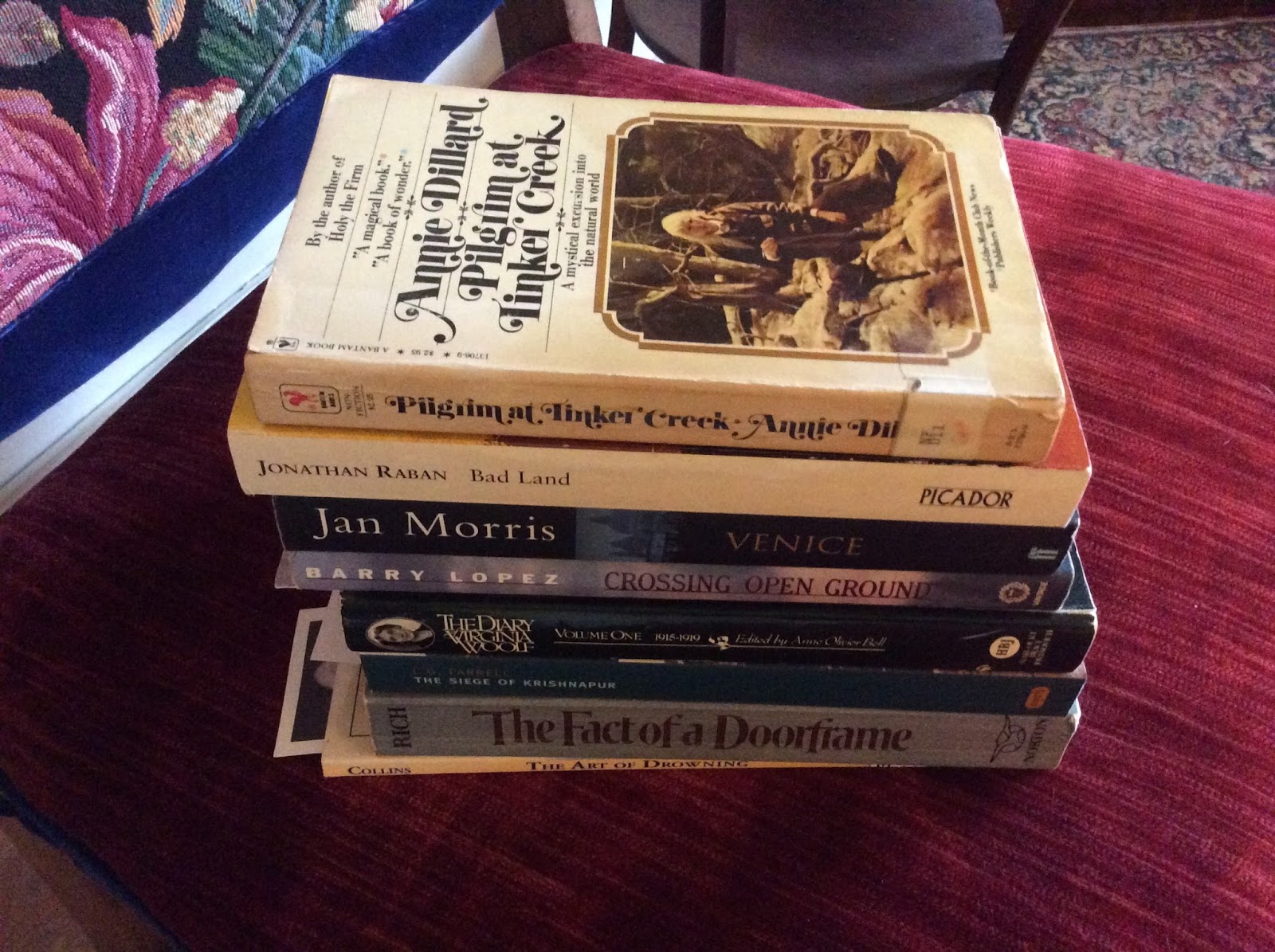
So here is the challenge: Read 16 books from your To Be Read stack in 2016. Here are mine:
Stack #1
Stack #2
Stack #1:
Jonathan Strange & Mr Norrell, Susanna Clarke
Currently on page 234, so have a head start but will finish in 2016 so it counts
Love Medicine, Louise Erdrich
The Song of the Lark, Willa Cather
The Leopard, Giuseppe Di Lampedusa
The Sea, the Sea, Iris Murdoch
Provence, Ford Madox Ford
Portrait of a Marriage, Nigel Nicolson
The Virginia Woolf Reader, ed. Mitchell A. Leaska
Stack #2:
Pilgrim at Tinker Creek, Annie Dillard
Bad Land, Jonathan Raban
Venice, Jan Morris
Crossing Open Ground, Barry Lopez
The Diary of Virginia Woolf, Volume One 1915-1919, ed. Anne Olivier Bell, Introduction by Quentin Bell
The Siege of Krishnapur, J.G. Farrell
The Fact of a Doorframe, Adrienne Rich
The Art of Drowning, Billy Collins
Happy New Year, and gather those books for the 2016 Reading Challenge!!!
Subscribe to:
Posts (Atom)