Showing posts with label Exploration. Show all posts

Sunday, July 24, 2016

Thoreau of the Desert


It is not the answer that enlightens,
but the question.
---Eugene Ionesco


Desert Solitaire, a 2016 Reading Challenge book, has been in my mental To Be Read (TBR) stack for many years. The title beguiles me and has kept me from reading the book because I was afraid it would disappoint, as if the title was too beautiful for what may follow. I have not been disappointed.

Desert Solitaire epigraph:

Give me silence, water, hope
Give me struggle, iron, volcanoes
-- Neruda


Delicate Arch

Edward Abbey worked as a seasonal Park Ranger at what was then called Arches National Monument in Utah, in the late 1950s. He lived twenty miles away from the nearest house in a "little tin government house trailer". Mice-ridden, (an adopted gopher snake took care of them), freezing cold in April, stifling hot in July, equipped with the bare necessities for living, the trailer became a place to store food and belongings. When the weather turned warmish, he built a lean-to "ramada" and a fire pit and moved outdoors, where he slept under the stars. Desert Solitaire was written ten years later from the journals Abbey kept during his seasonal work at the Arches.

From Abbey's Introduction:

This is not primarily a book about the desert. In recording my impressions of the natural scene I have striven above all for accuracy, since I believe that there is a kind of poetry, even a kind of truth, in simple fact. But the desert is a vast world, an oceanic world, as deep in its way and complex and various as the sea...If a man knew enough he could write a whole book about the juniper tree. Not juniper trees in general but that one particular juniper tree which grows from a ledge of naked sandstone near the old entrance to Arches National Monument. What I have tried to do then is something a bit different. Since you cannot get the desert into a book any more than a fisherman can haul up the sea with his nets, I have tried to create a world of words in which the desert figures more as medium than as material. Not imitation but evocation has been the goal.

Edward Abbey held strong views about modern America's attitude to wilderness. He could not abide the superficial way most tourists visited the Arches. His "word of caution" regarding "industrial tourism":

Do not jump into your automobile next June and rush out to the Canyon country hoping to see some of that which I have attempted to evoke in these pages. In the first place you can't see anything from a car; you've got to get out of the goddamned contraption and walk, better yet crawl, on hands and knees over the sandstone and through the thornbush and cactus. When traces of blood begin to mark your trail you'll see something, maybe...

Some have attributed Abbey with the beginning of the Earth First! movement and ecoterrorism. His book The Monkey Wrench Gang is about sabotaging a dam construction project in the Southwest, so it is kind of understandable that he would be seen as a proponent of drastic means to stop man's destruction of the natural environment. Abbey strenuously denied that he supported ecoterrorism. However, in Desert Solitaire, he admits to tearing out several miles worth of new road survey markers near his trailer house. A very naughty protest, but not ecoterrorism.

Rattlesnakes, wildflowers, poisonous water springs, fresh water springs, cliff seeps and hidden grottoes, flash floods, quicksand, range cattle, and uranium are described in beautiful prose in this masterpiece of nature writing. One of the most interesting things to me is that according to Abbey, the beautiful land forms in the Arches are not the result of wind erosion, but of the slow drip of water and the effects of contraction and expansion of cold and heat over eons of geologic time.


Lake Powell, Glen Canyon

Abbey describes not only his surrounds in the Arches, but a river raft trip down the Colorado through Glen Canyon, as the dam was being built. It is heartbreaking to know that the beauty he describes is now deep under water and silt, buried forever. Even if the dam is not permanent, the silt is. His solitary foray up the side canyon where the Escalante River enters the Colorado is my favorite part of the book. He finds the ruins of a cliff dwelling perched high up the canyon wall. It is all now buried forever. And sadly, Glen Canyon Dam was built not for irrigation but for electricity so that hordes of people could live in the desert southwest.


Mt. Tukuhnikivats in the La Sal range

We accompany Abbey on a camping trip and solitary climb up one of the highest mountains overlooking the Arches, Mt. Tukuhnikivats. And, we go to the bottom of Grand Canyon where Abbey spent 35 days camped near the Native American village of Havasu. While there he nearly trapped himself on a ledge while exploring the area around his camp. He worked his way down a cliff side and was stranded. Piling rocks and then centering his walking stick in the pile, he climbed up to the tip of his stick and used it as a launch to jump up to a handhold in the rock above. Risky.


Havasu Falls, Grand Canyon


The Maze

This same fearless attitude sent him and a friend to The Maze, a no-man's-land of canyons (now part of Canyonlands National Park). At the time, they were barely able to get into the area with a Land Rover. They repelled down a cliff face to the maze itself, not knowing if they would find a way to climb back up. Yes, risky but Abbey described himself as "not an atheist but an earthiest". He believed one should "be true to the earth". He was not afraid because he did not separate himself from the environment.

He believed in the desert.

"The finest quality of this stone, these plants and animals, this desert landscape is the indifference manifest to our presence, our absence, our coming, our staying or our going. Whether we live or die is a matter of absolutely no concern whatsoever to the desert."

The title Desert Solitaire is perfect for this book. It is beautiful. The book is beautiful. I will read it again.

P.S. While recuperating from hand surgery, I could hardly hold a book in my hands for more than a few minutes. This is what I did as I inched my way through Desert Solitaire:




Sunday, December 27, 2015

Back to (Almost) Normal, Falling Off the Mountain, A Reading Challenge

**NEWS FLASH** I AM BACK!!!!!!!!!!

If you read my blog, thank you very much! I hope you missed me -- I missed you! Feeling much better, not quite 100%, but getting close. I have missed blogging very much and am quite happy to be back.

During this hiatus, I have had lots of time for reading and reflection. Health issues have a way of focusing the mind. And, in times of crisis some important things are no longer important. Please pardon the confessional bits here -- I have always taken too much pride in my smarts. I have smarts. But, I also lack the common sense gene. I admit it! I set high expectations for myself because I have to live up to my smarts, but the reality is, I spend (spent!) a lot of time doing this and that because I thought it was absolutely necessary to accomplish these things. One of these "things" is reading Ulysses. So, in the spirit of stepping away from what I used to think was SOOOO important, I am calling a halt to the Mt. Ulysses expedition. I was very enthusiastic and enjoyed the endeavor at first. While down and out I felt guilty for not reading, listening, or researching Ulysses and Joyce. As I began to feel better, I started listening to the dramatization again and realized it did not appeal to me at all. In fact, it was boring, tedious, unintelligible, and too much WORK. It became obvious that I was no longer enjoying myself and if I am retired and in control of my own doings, why do something so awful? Clarity is good. So, thanks to the gods of recuperation, I am embarking on new adventures and leaving James Joyce and his genius behind. I hope no one is disappointed, (she smirks). We are officially OFF the mountain! Fair warning, this might not be the only project I abandon. If a book does not grab me I will let it go.

First things first before we can really move on. Let's clear our agenda for a fresh start in 2016. Taking stock of past reading projects I see we have three unfinished sojourns.

-- The Collected Stories of Colette
-- The Mountains of the Moon
-- Pepys' Diary

All are worth finishing, so look for coming posts on these in the new year.

I am still using LibraryThing and its Legacy Libraries feature as my reading guide. So far, I share books in my library with 52 Legacy authors (there will be more when I have cataloged my entire library). Homer's works are those most commonly shared, 34 out of 52 authors having at least one of his works in common with me. I have read and discussed Homer so we are done with him, unless his work becomes part of another discussion. Moving forward, I want to divide my reading and the direction of this blog into several "groups". Since I have always had more than one book going at the same time, I want to keep (loosely) to something like this:

-- History & The Classics

-- Biography, Diaries, Letters

-- Travel, Nature

-- Literature, Poetry, Essays

-- 2016 Reading Challenge

-- Everything Else (includes art, movies, and life in general)

Finally, at this time of year there are tons of "Best of" lists and reading challenges for the coming year. One of the challenges I have always enjoyed (but have never accomplished because I am easily distracted) is the "Read xx number of books in the coming year" kind of thing. Without formally joining a challenge on another blog, I am creating my own challenge. You, dear reader, are not required to join in, but it might be fun for you to stroll through your "To Be Read" stack and pick out your own books to read in 2016. Clear those decks, forget resolutions, just read!

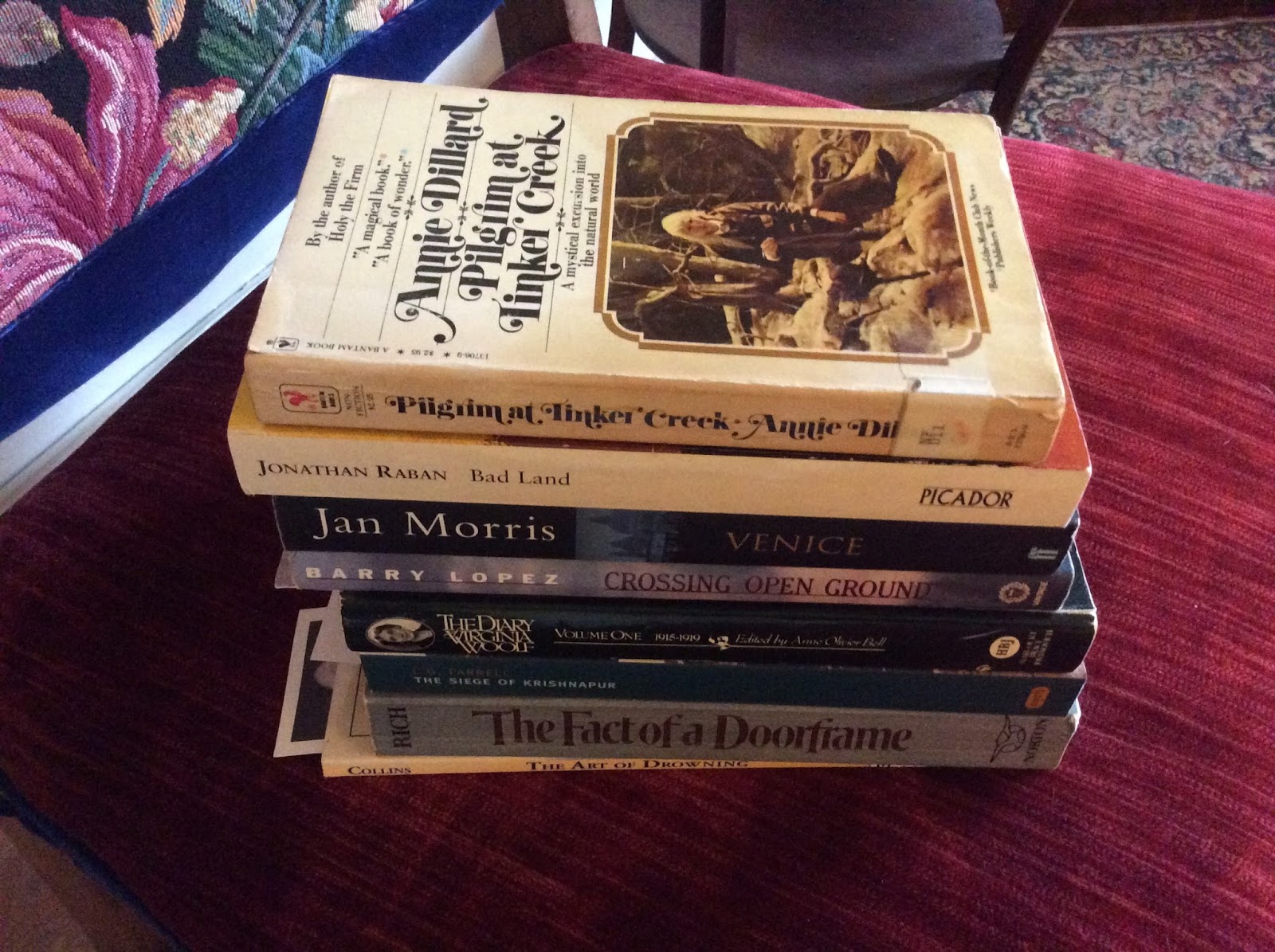
So here is the challenge:  Read 16 books from your To Be Read stack in 2016. Here are mine:


Stack #1


Stack #2

Stack #1:

Jonathan Strange & Mr Norrell, Susanna Clarke
     Currently on page 234, so have a head start but will finish in 2016 so it counts

Love Medicine, Louise Erdrich
The Song of the Lark, Willa Cather
The Leopard, Giuseppe Di Lampedusa
The Sea, the Sea, Iris Murdoch
Provence, Ford Madox Ford
Portrait of a Marriage, Nigel Nicolson
The Virginia Woolf Reader, ed. Mitchell A. Leaska

Stack #2:

Pilgrim at Tinker Creek, Annie Dillard
Bad Land, Jonathan Raban
Venice, Jan Morris
Crossing Open Ground, Barry Lopez
The Diary of Virginia Woolf, Volume One 1915-1919, ed. Anne Olivier Bell, Introduction by Quentin Bell
The Siege of Krishnapur, J.G. Farrell
The Fact of a Doorframe, Adrienne Rich
The Art of Drowning, Billy Collins

Happy New Year, and gather those books for the 2016 Reading Challenge!!!


Monday, August 24, 2015

Ruwenzori - Mountains of the Moon Part I

"Around this bay the Anthropophagi Aethiopians dwell, and from there towards the west are the Mountains of the Moon from which the lakes of the Nile receive snow water."
--Ptolemy (90 AD-168 AD) Book 4, chap. viii


"Here the silence was the voice"

Let's take a journey to Africa, shall we?

In an old car named Boanerges we haul ourselves from Kampala, Uganda to the foothills of the Ruwenzori  or the "Mountains of the Moon". It is December, 1934 and we are part of a "...British Museum Expedition to East Africa organized for the purpose of studying the flora and fauna of the equatorial mountains in relation to their peculiar environment." We are hoping to investigate two "hitherto almost unknown valleys ascending from the south and the southeast", the Nyamgasani and the Namwamba. We know there is a string of eight lakes near the top of the range, discovered by air a few years earlier.

 
 Ruwenzori "Mountains of the Moon" due west from Kampala

We have turned south at Fort Portal and are nearing the southern tip of the Ruwenzori. We are hoping to locate our base camp at the farm of a Captain Chapman. After many hours of unloading and loading our supply lorry and vehicles so we can cross the flimsiest of bridges, we continue until the road ends.  At this point, traveling by foot, our porters hired in Kampala carrying our supplies, we hike into the foothills to Captain Chapman's farm.


On the way to Captain Chapman's farm

At the farm, Captain Chapman has agreed to let us use a logging camp up the hill from his house as our base camp. He will also manage the base camp for us, sending up supplies in relays throughout our stay. At the farm we hire more porters. "They were Bakonjo, pleasant and friendly fellows, but much less civilized than the majority of the Uganda peoples...They are an ancient race, since they have been little affected by the Hamitic waves from the north and north-east, merely retiring before them, like the Celts, to the mountains, where they have preserved their old language."

One of the porters is a "rain man". We are here during the dry season in Uganda but expect bad weather anyway based on reports from previous expeditions.  Luckily for us, when dark clouds roll in as we trek up the mountain, the rain man climbs the nearest small hill, stands at the top with a flute-like whistle and blows a few blasts to keep the rain away.  "An uncanny success seemed to attend his efforts...and we ourselves almost began to believe in the power of the whistle."

As Captain Chapman has warned us, we have to cut a trail through the thick undergrowth and bamboo. "It was all unknown ground. There was no track. We had to cut a path all the way. We soon got used to the routine. We cut generally for two or three days; then all the porters were massed for moving camp. The next day we started cutting again. One of us would...go ahead with the porters. Somerville (our artist) would draw...while I would gather plants and take photographs."

Continuing on this way up, up the mountain we come and finally reach higher elevations where the going is easier and the plants become giant specimens of common plants found in our more temperate zones. 15-foot tall flowering lobelias, 50-foot tall heather "trees". Think of the pretty blue lobelias we plant in the spring, only with huge flower spikes, and normally one-foot tall heather bushes turned into trees 50 feet high.


As we continue to gather specimens and photograph strange new plants and mosses, we see very little signs of animal life. There are Colobus and "blue" monkeys at the lower elevations. Also large purple slugs on the bamboo. Higher up we see "hyrax", a small rodent-like animal used for meat and fur by the porters. We see little blue "sunbirds" (African hummingbirds) work the blue flower spikes of the giant lobelias. Very little else except for crows and birds resembling starlings.


Ruwenzori Close-Up

As we finally approach the highest elevations, the porters become skittish about the mountains and lakes. They are very superstitious and will not camp near any lake. We find rock outcroppings for their shelter and set up camp "proper" near a large lake, one of the eight discovered by air. "We were standing almost on the Equator, yet it was as cold as a really cold winter's day in England, and a little ahead there was permanent snow and ice."

Two of us set out to climb to the top of the highest peak above our camp, Weismann Peak. All the snow peaks, Mt. Stanley, Mt. Speke, and Mt. Baker are visible from the top. On the south side of Weismann Peak is a glacier, one of those feeding the high mountain lakes, and eventually, the Nile River. As we take in the long view, we see a strange cloud next to our camp down below. We realize it is smoke, and rush down as fast as we can, only to find a burnt out campsite. Moving down to the rock shelter, we find our colleague and the porters are safe. A gust of wind blew flames from the campfire beyond the safety zone and set dry moss and brush on fire as well as our tent and sleeping gear. No samples were lost, thank goodness! But, it means an early departure down the mountain.

As we descend, we gather more plant samples, and laugh at our strange outfits -- remnants of burnt clothes, and tent flaps! When we reach the lower elevations, we have to cut our trail again, although not as time consuming as when we climbed up the mountain.

Back at base camp, we take a long relaxed rest. Smoke from intentional grass fires has cut visibility and our mountains are lost in the haze. A huge swarm of locusts comes through the area turning the sky even darker as they pass over. A very strange thing happens. A stork falls out of a tree, nearly unconscious. It is determined he has gorged himself on locusts. After several hours he recovers but is too weak to fly. He stays for several days and enjoys the attention, allowing us to scratch his chin! Finally, he flies away, headed to one of the large lakes in the area.

We hear news of our other group, back from their northern approach to the mountain. They have also had a successful trip. Our southern approach is not the easiest way to reach the high elevations, but we think it must be the most beautiful. Feeling satisfied with the results of our journey thus far, we settle in to label and pack specimens and reflect on Ruwenzori.


And now, it is time to make plans for the next stage of our journey--a plant safari on Mount Elgon.


Friday, July 24, 2015

Dreaming of the Arctic and Africa

On Fridays My Reading Road Map will go outdoors.  We will visit far away places or nearby gardens. We will investigate the natural world.  I found two books in the stacks Wednesday that shout "faraway places" so I want to give them a mention today.

Arctic Dreams

The first book is "Arctic Dreams:  Imagination and Desire in a Northern Landscape" by Barry Lopez, a philosophical nature writer who lives nearby in the Cascade foothills of western Oregon.  Lopez won the 1986 National Book Award for Nonfiction for this book.


My copy is a well-used 1986 Scribner's large paperback, and a whopping 464 pages.  I am on page 313, so on the home stretch to the finish.  I have started this book and put it down several times over the years.  For some reason it was never the right time.  Now I know to read it is a privilege and this is why.

Barry Lopez writes about Arctic land and seascapes, the creatures who populate them, and the history of Western exploration and exploitation of them with a quiet contemplative voice. Maybe I needed to be quiet to read it.

Here is a small sample from the preface.  Lopez is writing about a summer evening walk through the tundra in the western Brooks Range of Alaska.


“…it was on that evening that I went on a walk for the first time among the tundra birds.  They all build their nests on the ground, so their vulnerability is extreme.  I gazed down at a single horned lark no bigger than my fist.  She stared back resolute as iron.  As I approached, golden plovers abandoned their nests in hysterical ploys, artfully feigning a broken wing to distract me from the woven grass cups that couched their pale, darkly speckled eggs.  Their eggs glowed with a soft, pure light, like the window light in a Vermeer painting…I took to bowing on these evening walks.  I would bow slightly with my hands in my pockets, toward the birds and the evidence of life in their nests—because of their fecundity, unexpected in this remote region, and because of the serene arctic light that came down over the land like breath, like breathing.”

He "took to bowing" to the birds.  The profoundness of this has stayed with me throughout this book.  I will never forget the quiet reverence of those words.

Soon we will return to the Arctic.  We will talk about musk oxen and polar bears, narwhals and ring seals.  We will discuss ice and northern lights, the Thule people and ancient willow and birch forests so short one can walk over the top of them.  We will also think about this artwork by Frederic Edwin Church.


Finally, the chapter I am reading now is titled "The Intent of Monks".  Quietness indeed.

Mountains of the Moon

The second book from Wednesday's stacks is "Mountains of the Moon:  An Expedition to the Equatorial Mountains of Africa." by Patrick M. Synge.  Another book I have had for decades, in this case still unread.


As you see in the picture, this book came from Fermin Lasuen High School library in San Pedro, California.  It is one of my original 3,000 volume library and is considered an "ex-library" book to collectors.  These are looked down upon as much as Book Club editions in that world.  Mine is a third edition, printed in London in 1938.  It is badly damaged but contains two beautiful "coloured plates" one of which you can see in the picture, "The Lake of Death", Seventh Nyamgasani Lake.  There are 91 "collotype plate" illustrations and two maps, one a pull-out folding map.

Right now all I know about this book is the physical description I have shared with you.  From a book review on Goodreads:


“In 1934, Patrick Synge travelled on an expedition sponsored by the British Museum of Natural History to the Ruwenzori range in East Africa, purported to be the "mountains of the moon" spoken of by Herodotus.  Synge, a botanist, was immediately enchanted by the place. His book is, in large part, an enthusiastic and good-natured account of the things that most impressed him. Being a botanist, his most vivid writing concerns plants, but I must say that seldom have I read more captivating descriptions of local scenery, flora, and fauna.”

We will return to the "Mountains of the Moon" again, I promise.