Showing posts with label Colette. Show all posts

Sunday, December 27, 2015

Back to (Almost) Normal, Falling Off the Mountain, A Reading Challenge

**NEWS FLASH** I AM BACK!!!!!!!!!!

If you read my blog, thank you very much! I hope you missed me -- I missed you! Feeling much better, not quite 100%, but getting close. I have missed blogging very much and am quite happy to be back.

During this hiatus, I have had lots of time for reading and reflection. Health issues have a way of focusing the mind. And, in times of crisis some important things are no longer important. Please pardon the confessional bits here -- I have always taken too much pride in my smarts. I have smarts. But, I also lack the common sense gene. I admit it! I set high expectations for myself because I have to live up to my smarts, but the reality is, I spend (spent!) a lot of time doing this and that because I thought it was absolutely necessary to accomplish these things. One of these "things" is reading Ulysses. So, in the spirit of stepping away from what I used to think was SOOOO important, I am calling a halt to the Mt. Ulysses expedition. I was very enthusiastic and enjoyed the endeavor at first. While down and out I felt guilty for not reading, listening, or researching Ulysses and Joyce. As I began to feel better, I started listening to the dramatization again and realized it did not appeal to me at all. In fact, it was boring, tedious, unintelligible, and too much WORK. It became obvious that I was no longer enjoying myself and if I am retired and in control of my own doings, why do something so awful? Clarity is good. So, thanks to the gods of recuperation, I am embarking on new adventures and leaving James Joyce and his genius behind. I hope no one is disappointed, (she smirks). We are officially OFF the mountain! Fair warning, this might not be the only project I abandon. If a book does not grab me I will let it go.

First things first before we can really move on. Let's clear our agenda for a fresh start in 2016. Taking stock of past reading projects I see we have three unfinished sojourns.

-- The Collected Stories of Colette
-- The Mountains of the Moon
-- Pepys' Diary

All are worth finishing, so look for coming posts on these in the new year.

I am still using LibraryThing and its Legacy Libraries feature as my reading guide. So far, I share books in my library with 52 Legacy authors (there will be more when I have cataloged my entire library). Homer's works are those most commonly shared, 34 out of 52 authors having at least one of his works in common with me. I have read and discussed Homer so we are done with him, unless his work becomes part of another discussion. Moving forward, I want to divide my reading and the direction of this blog into several "groups". Since I have always had more than one book going at the same time, I want to keep (loosely) to something like this:

-- History & The Classics

-- Biography, Diaries, Letters

-- Travel, Nature

-- Literature, Poetry, Essays

-- 2016 Reading Challenge

-- Everything Else (includes art, movies, and life in general)

Finally, at this time of year there are tons of "Best of" lists and reading challenges for the coming year. One of the challenges I have always enjoyed (but have never accomplished because I am easily distracted) is the "Read xx number of books in the coming year" kind of thing. Without formally joining a challenge on another blog, I am creating my own challenge. You, dear reader, are not required to join in, but it might be fun for you to stroll through your "To Be Read" stack and pick out your own books to read in 2016. Clear those decks, forget resolutions, just read!

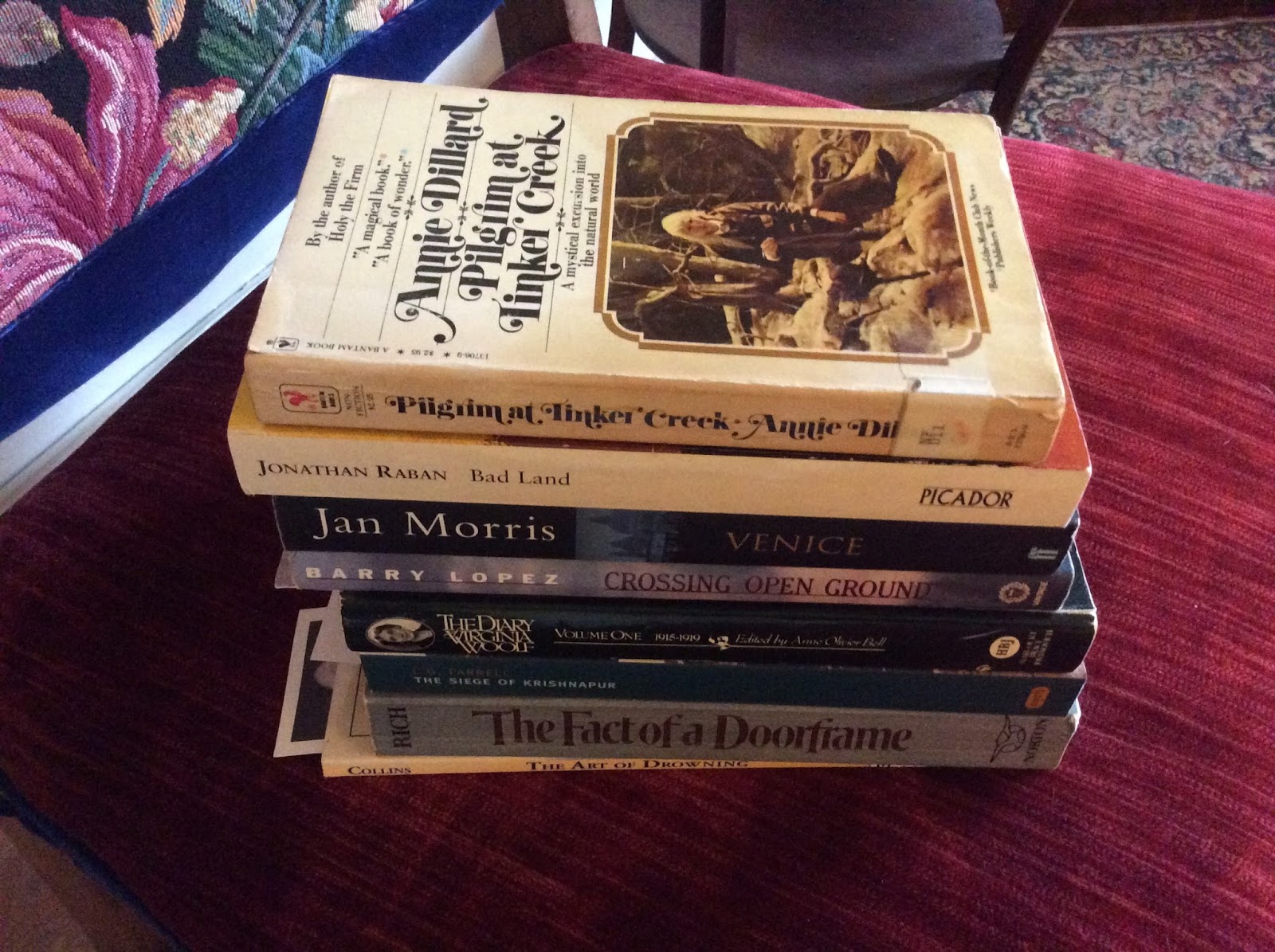
So here is the challenge:  Read 16 books from your To Be Read stack in 2016. Here are mine:


Stack #1


Stack #2

Stack #1:

Jonathan Strange & Mr Norrell, Susanna Clarke
     Currently on page 234, so have a head start but will finish in 2016 so it counts

Love Medicine, Louise Erdrich
The Song of the Lark, Willa Cather
The Leopard, Giuseppe Di Lampedusa
The Sea, the Sea, Iris Murdoch
Provence, Ford Madox Ford
Portrait of a Marriage, Nigel Nicolson
The Virginia Woolf Reader, ed. Mitchell A. Leaska

Stack #2:

Pilgrim at Tinker Creek, Annie Dillard
Bad Land, Jonathan Raban
Venice, Jan Morris
Crossing Open Ground, Barry Lopez
The Diary of Virginia Woolf, Volume One 1915-1919, ed. Anne Olivier Bell, Introduction by Quentin Bell
The Siege of Krishnapur, J.G. Farrell
The Fact of a Doorframe, Adrienne Rich
The Art of Drowning, Billy Collins

Happy New Year, and gather those books for the 2016 Reading Challenge!!!


Friday, October 23, 2015

Let's Bury the Wine


Curemonte, France

It is lovely, isn't it, this quiet medieval village in central France with its chateaus and imagined winding cobbled streets. Are the crumbling ruins of a chateau still hiding there, on a hill overlooking the village? Those ruins, where Colette, nearing 70, took refuge in the summer of 1940 after the German army entered the outskirts of Paris. Colette writes:

"We have been here since 15 June. We had to leave on the fourteenth or the thirteenth, because the Germans had reached Mere. And I wanted to stay. And despite everything, I regret not having stayed. Curemonte, in ruins, has been loaned to my daughter by one of her brothers. We are waiting, and with such a hunger, to go back to Paris as soon as there is a route open. Not enough petrol...
'When it rains, the damp soaks into and revives the colours of the little dome, twelve or fifteen feet above our heads, which forms the roof of a little circular room in the ruin. In dry weather, the same paintings, apparently dating from the Renaissance, turn pale and powdery. We gaze up at them from below, there is not a single wall solid enough to lean a ladder against. These inexpungeable frescoes, consisting entirely of geometric decorations converging on the keystone of the dome, are painted very closely over a background of dark stone. They once enlivened with their yellows, their blues, and their olive greens, the solitary state of a Lady who kept herself warm without the aid of a fire, her feet tucked up in her great skirt...
'It is her bedroom that we are burning, its wooden panels carved into flowers and picked out in colours; under the paint it is crumbling away and as soft as sponge. From her little square window, the Lady used to see the invader, the ally, and the merchant mount the hill; she used to watch for the approach of what we lack: her freshly churned butter, her honeycombs, her rents paid in kind with chickens strung up by their legs, and the fine-ground flour...The curfew was not, as it is for us, the moment to be dreaded above all other, the moment when we all know that we can no longer count on anyone but ourselves until the coming of the clear dawn, cold as in all mountain districts, and heralded by a hundred goldfinches perched on the tips of the pea stick."

She remained in the chateau ruins with her husband, her servant Pauline, and her daughter Bel-Gazou's family for only a short time. In September she made her way back to Paris ("I'm used to spending my wars in Paris!"). The following year her husband, a Jew, was arrested by the Gestapo and interned. He was released several months later and left Paris to escape possible re-arrest. Suffering from arthritis, Colette remained in Paris.

I am continually in a swoon as I read Colette. Her writing is evocative, beckoning, picks me up and swoops me back in time. I hover over her shoulder while she, at her desk near a window in her beloved Palais-Royale apartment, scribbles on sheets of light blue paper (her "fanal bleu, or blue beacon light"). 


Nearing the end of Earthly Paradise, her collection of memoir pieces, I think her writing is getting stronger, more alive. A lifetime of writerly observation has given her pen a knife-like edge. She chronicles her life with a keen sense of certainty. And, her mother, Sido, remains the major influence on her outlook.

Writing about her own experience during WWII, she remembers how Sido reacted to her first glimpse of a Prussian soldier on a country lane in Burgundy during the Franco-Prussian War of 1870: 

"It was up in Fox Lane...At dusk there is almost always a mist up there, along Fox Lane, because the spring is smoky then. So there I was, and I saw a soldier with a spike on his helmet standing in the middle of the lane. He was holding his rifle as though it was a shotgun. I could just make out that he had a thick, short beard. I think he was a Bavarian. Because of the dusk and the mist, there was no way of telling the colour of his uniform or of his beard. And for a moment I had the impression that the whole German Army must be composed entirely of grey men just like him, grey clothes, grey faces, grey hair, like people in engravings...
'What did you do?
'I went straight home and buried all the best wines."

Of course.


Thursday, October 1, 2015

Serendipity

I had planned to write about Sylvia Beach today. I finished Shakespeare and Company last night and want to share her stories about James Joyce and other ex-pats in the Paris literary world of the 1920s. However, that will have to wait because of a bit of Serendipity to start my day.


Eric Clapton


Delaney Bramlett


Leon Russell

This morning over coffee, my husband shared a tidbit from Eric Clapton's Clapton, The Autobiography about the musical genius of both Delaney Bramlett (of the group Delaney & Bonnie) and the rocker Leon Russell. How they could both compose perfect lyrics out of thin air. My husband is very deep into the connections between various blues and rock musicians so this conversation was not that unusual.

Speaking about Delaney Bramlett and Leon Russell, Clapton says:

"...we would be on the way to the studio in the morning and Delaney would say, 'What about a song about a bottle of red wine?' and he would start singing, 'Get up and get your man a bottle of red wine...' It would just flow out of him, and by the time we got to the studio, the song would be finished. I remember thinking to myself, 'How does he do it? He just opens his mouth and out comes a song.' We'd go straight to the studio and record it live. Then I would put a couple of vocal tracks down, with Delaney coaching me, and then it would be time for the girls and the horns. Rita and Bonnie would be given their parts and they'd sing it, Jim and Bobby would put some riffs on, and that was the whole thing wrapped up...Delaney had brought out something in me that I didn't know I had...Making that record was one of the most important steps I would ever take, it was a truly memorable experience. I remember going in one day when we didn't have a song planned, and Leon came up to me and said, 'I've got a line for you', and thinking aloud, he said 'You're a blues musician, but people don't know that you can also rock 'n' roll, so we can say...

'I bet you didn't think I knew how to rock 'n' roll.
Oh, I got the boogie-woogie right down in my very soul.
There ain't no need for me to be a wallflower,
'Cos now I'm living on blues power.'

Just like that, no effort, and that was the birth of the song 'Blues Power', one of my favorite songs on the album."

By the way, the "Rita" mentioned above is Rita Coolidge!  Those connections...!  Here's lovely Rita:


And this is where the Serendipity comes in:


Colette's Memoir

As you know from previous posts, I am interested in the power of genius. I am also interested in the power of the muse, manifested through whatever medium the artist chooses -- words, music, painting, sculpture, etc. So, after our morning coffee, I was still pondering Clapton's account of  lyric-writing genius and musical collaboration when I picked up Colette's memoir, Earthly Paradise. Amazingly, she is writing about the same exact creative process Clapton was! Here is how she describes an encounter with the creative musical genius of Claude Debussy:


Claude Debussy

"All my meetings with Claude Debussy took place in the sonorous warmth, the delicate fever of an exclusively musical atmosphere. A composer at the piano, a singer leaning back with his elbows resting on its bare top, or a woman singer, not leaving her armchair, but singing, exhaling the melody like a cloud of unconsidered smoke, head tilted back...At such times, Debussy seemed to become intoxicated by the music. His ambered satyr's face, his spiralling locks of hair, in which the eye instinctively sought for a glimpse of vine leaves and grapes, would quiver with an inner delirium. In moments of fixed intensity, his pupils would cross their sight lines slightly, after the fashion of hunting animals hypnotized by their own watchfulness. It seemed to me that he loved music in the way a crystal tulip loves the shock that draws a pure note tingling from its bowl. One Sunday evening, after hearing 'Antar' played for the first time in France, unless perhaps it was 'Scheherazade', we both chanced to go on the same party, and Debussy, obsessed, overcome, was singing his symphonic memories of the work inside himself. He was giving out a sort of bee-swarm buzzing, something like the sound you hear from telegraph poles, a groping and hesitant murmur. Then the memory grew more precise, and his closed face suddenly opened.
'Wait! Wait!' he said very loudly. 'Like that...mmmmm...and like this: mmmmm...'
One of us caught at this remembered shred of melody before it could fly away again, and drew it out a little further.
'Yes, yes', Debussy cried. 'And then at the same time there are the cellos lower down, saying: mmm...And the kettledrums, oh heavens, the kettledrums, just the faintest murmur to tell us there's that explosion coming from the brass, and...and...'
Lips pursed, then miaowing as he went on to imitate the violin, he panted on, torn apart by all the different timbers vying for places in his memory. With the poker clenched firmly in one hand, he hammered on the rosewood of the piano. With the other he made a zzzzzzzzzzing! sound against the windowpane, then plopped his lips together drily to re-create the xylophone, and made a sound of 'duk, duk' in a voice like crystal, to recall for us the liquid notes of the celesta.
He stood up, using his voice, his arms, and his feet all at once, while two black spirals of hair danced on his forehead. His faun's laugh rang out in reply, not to our laughter, but to some inner solicitation, and I engraved at that moment in my memory this image of the great master of French music in the process of inventing, before our very eyes, the jazz band."

OK, Claude Debussy is no jazz artist, but the creative process, the ability to pull orchestration out of thin air and physically manifest it -- oh, to have seen that!

Sylvia Beach will appear very soon because she has a lot to say about associations and creative genius too.

Here are some samples of the music mentioned in this post. Enjoy!

Bottle of Red Wine

Blues Power

Debussy Arabesque No. 1 (an example of Debussy's style, actually quite subdued compared to the picture Colette painted above)

--Note--I am having terrible difficulties with my old laptop. It is running Windows Vista and things have gone downhill very badly all of a sudden. I am taking a short break until I get a new computer. See you on the other side!


Sunday, September 27, 2015

Spider Season and the Bowl of Hot Chocolate

Summer is definitely gone. We know this because our autumn visitors have arrived. They show up all of a sudden, a scurry across the living room floor, a captive in the kitchen sink, a still brown shape on the wall next to the bed, ugh...


Eratigena atrica, aka Common House Spider

Sorry, "Common" is a bit mild. How about "Scary House Spider", or "Giant House Spider", or "The Heart Attack"? Apparently the specimen pictured above is about average size for the "Air-uh-TIH-gen-uh-aa-TRICK-uh. This one looks like its leg span is about 2.5 inches. The largest can reach up to 4 inches!

My husband rescued this thirsty guy (gal?) from the kitchen sink. "C" used to be extremely arachnaphobic but for some reason, this year, he has decided these are good spiders, we should not kill them, we should rescue them and put them outdoors. OK, I get it, but they will just come back inside. According to Wikipedia:

"This species is native to Europe but was introduced to southern Vancouver Island, British Columbia in the early 20th century, and has since spread to mainland British Columbia as well as Washington and Oregon...Most specimens mature in the summer or fall and mate shortly thereafter. On warm nights in the summer and fall, the adult males wander in search of mates and may be caught scurrying across the floor when the lights are turned on. Females will typically construct more than one egg sac in their lifetime, and will suspend them in  her web...These large spiders help prevent 'hobo spiders' from becoming established indoors. They out-compete and displace the hobo spider indoors and the males often kill male hobo spiders (without necessarily eating them). Hobo spiders are not an indoor spider to begin with, but Eratigena atrica is helping to keep them that way."

Since "hobo spiders" are poisonous, and we do have them in this area, the Common House Spider is a good one to have around even if they scare the beejeezus out of me! It is the startle factor.


Colette has a charming little story about her mother's pet house spider. From My Mother's House, a memoir of growing up in Burgundy, Colette tells us:

"Have you ever heard tell of Pelisson's spider that so passionately loved music? I for one am ready to believe it and also to add, as my slender contribution to the sum of human knowledge, the story of the spider that my mother kept--as my father expressed it--on her ceiling, in that year that ushered in my sixteenth spring. A handsome garden spider she was, her belly like a clove of garlic emblazoned with an ornate cross. In the daytime she slept, or hunted in the web that she had spun across the bedroom ceiling. But during the night, towards three o'clock in the morning, at the moment when her chronic insomnia caused my mother to relight the lamp and open her bedside book, the great spider would also wake, and after a careful survey would lower herself from the ceiling by a thread, directly above the little oil lamp upon which a bowl of chocolate simmered through the night. Slowly she would descend, swinging limply to and fro like a big bead, and grasping the edge of the cup with all her eight legs, she would bend over head foremost and drink to satiety. Then she would draw herself ceiling-wards again, heavy with creamy chocolate, her ascent punctuated by the pauses and meditations imposed by an overloaded stomach, and would resume her post in the centre of her silken rigging."

Oh my. To be so in tune with the creatures who inhabit one's world. I would like to have known Colette's mother, Sido. She counted the four cardinal points as either friends or enemies (the East wind was always an enemy) depending on circumstances. Her world was one of nurturing family, farmhouse, animals, and every square inch of garden on her little plot of land. She was one of that ancient race who still believe in..."The mists of a  primitive religion--belief in fairies, in charms, in sorcerers--(that) everywhere lingers over French fields" (A. Maurois, A History of France).

Sigh, there will be nothing so romantic as a  garden spider or common house spider lurking on my bedroom ceiling waiting for the moment when I invite her to share my bowl of hot chocolate. Rather, there will be a cry for "C" to move the poor thirsty thing outdoors immediately.  


Monday, September 21, 2015

Free to Soar

One of my elders passed away yesterday. A beautiful woman in every way. My mother's cousin, best friend, confidante. Now they are both free to soar.

Reading Colette this morning, I found this lovely passage about aging, thought it worth saving here, and so:

Setting the scene -- Colette is remembering her childhood and the magic of New Year's Day, her most special holiday. She is in Paris and has just returned from an evening romp in the snow with her two dogs. They are now warming themselves by the fire.

"Still under the spell of my daydream, I am astounded to find I have changed, have aged while I dreamed...I could repaint on this face, with a tremulous brush, that fresh childish face, toasted with sunlight, rosy with cold, the firm cheeks curving into a pointed chin, the mobile eyebrows prompt to frown, a mouth whose sly corners belie the short, ingenuous upper lip...Alas, for only a moment. The adorable velours of the resuscitated pastel brushes off and blows away...The dark water of the small mirror keeps only my image, which is quite, quite like me, marked with light scratches, finely lined at the eyelids, the corners of the lips, and between the stubborn brows...An image which neither smiles nor becomes sad, and which murmurs for me alone: 'One must grow old. Do not weep, do not join supplicating hands, do not revolt: one must grow old. Repeat this word, not as a cry of despair, but as the signal for a necessary departure. Look at yourself, look at your eyelids, your lips, raise from your temples the curls of your hair: already you are beginning to drift away from your life, don't forget it, one must grow old!

'Go away slowly, slowly, without tears; forget nothing! Take with you your health, your cheerfulness, your coquetry, the small amount of kindness and justice that rendered life less bitter for you; don't forget! Go away adorned, go gently, and do not stop on the irresistible way, you will try in vain to do so -- because one must grow old! Follow the road, and do not stop for rest except to die! And when you do lie down across the vertiginous undulating ribbon of a road, if you have not left behind you one by one your curly locks, your teeth, your limbs one by one worn out, if the eternal dust has not, before your final hour, weaned your eyes from the marvelous light -- if you have, to the very end, kept in your hand the friendly hand who guides you, then lie down smiling, sleep happy, sleep as one privileged...'


Joy and Paula


Tuesday, August 11, 2015

Reading Rest Area

We have grand kids this weekend, siblings from around the world in town, and a birthday party, so lots going on here at Reading Road Map Headquarters. What is NOT going on much is reading, as in reading for long stretches of time without interruption. Are there ever any such "stretches of time"?

Given the state of things here, this is what is going on right now on the Reading Road Map journey:

Finished "Arctic Dreams" and a post to come soon.

Reading Colette short stories, as well as "Earthly Paradise", an autobiography of sorts comprised of short pieces written by Colette.

Another M.F.K. Fisher book, "Two Towns in Provence".

Listening to "Five Red Herrings" by Dorothy L. Sayers, a free audio book download from my local library. I like this production because it is done as a radio play rather than a narrator reading the book.

Just barely beginning "The Mountains of the Moon", a trip to central Africa in the early part of the 20th century.  I pulled out one of our beautiful old 1950's map books to follow along with the British Museum Herbarium expedition to Ruwenzori, 'the mountains of the moon'.  The map book takes up almost half of the dining room table when opened out so I suspect it will not get to live there long.  This journey will go on hold until later this month.  The map books will be the subject of more than one post. They are close to the top of my list of favorite things.


Kenya and Uganda


Ruwenzori

I am also strolling through cookbooks as I plan the weekly menu.  What I am NOT doing, is going to book-related blogs to read reviews of new books, ordering new books, and moving them to the bookshelf to sit unread for who knows how long.  So far, so good!

Looking at the above list, one might think a bit of  "reading ADD" has returned. It looks like a scatterbrain list, but really, it does not feel like it in real life.

There might be a beautiful picture book about Leonard and Virginia Woolf's garden at Monk's House coming my way, but it will be a gift, so it does not count.  Right?


I Cannot Wait!
   

Monday, July 27, 2015

My Legacy Project Update: MFK Fisher and Colette

As of now, MFK Fisher and I share two books in common according to the Legacy Library listing on LibraryThing.  These are MFK's "As They Were" and "The Collected Stories of Colette".  I have made progress with both books since last week and here are my impressions so far.


As They Were

I meant to be farther along in this book by now as it is a collection of essays.  But I have been savoring every page and have about one hundred pages to go.  It is a beautiful book and is really very good.  From the back cover:

"...In As They Were she has collected a number of essays -- she calls them 'reports' -- into an informal autobiography that wanders from Whittier, California, to the south of France." -- Newsweek

So far, one story stands out, "The Flame and the Ash Thereof".  It is a hauntingly beautiful autobiographical short story about young marrieds vacationing in northeast France in 1931.  It is also a story about the bride's return in 1945, now on her own, after reading about the devastation wrought to her special little town by the Germans in WWII.  The before and after contrast is heartbreaking.  More than parts of the town disappeared, a way of life was also lost.  MFK draws one into both worlds.  It is a story I will never forget.

The little I had read of MFK Fisher before starting this project left me wondering if I would ever "get" her writing.  Now I have no doubts.  She is marvelous.

The Collected Stories of Colette

There are 100 stories in this collection, taken from various books by Colette.  They date from 1908 to 1945. Part I contains the "Early Stories".  The first section of Part I is "Clouk/Cheri", containing seven stories.

You might be familiar with the novella "Cheri", by Colette.  The seven stories in Part I are stand alone stories, but also show the evolution of the character Cheri from "Clouk".  Clouk is a miserable poor little rich boy, physically unattractive and is becoming ever more depressed over the loss of his actress girlfriend to another man. Colette turns Clouk into "Cheri", a young handsome bon vivant who loves an older woman but is forced into an arranged marriage.  The stories are very well-written, evocative of an earlier age, and quite charming in their way.

On my list of things to do as soon as I can fit it in is to watch this movie with Michelle Pfeiffer as "the older woman":

Cheri

I will check back in on this phase of My Legacy Project in a few weeks.  Also, look for a new page on the blog for MFK Fisher.  I will organize My Reading Road Map using Pages for each person whose Legacy Library I am reading.

Now, I am off for a couple of days so I can spend some family time here:


Peace and Quiet


Monday, July 20, 2015

M.F.K. Fisher

Imagine yourself hiking through the hills of central France, a woman on her own in the 1930s.  A common enough thing to be doing at that time, in that place.  Midday and time for a break.  You come upon an unlikely restaurant in a renovated old mill next to a stream.  This is the setting for the first Mary Frances Kennedy Fisher (MFK) story I ever read, "I Was Really Very Hungry".  I have no idea when or where I read it but it made an impression.

Before embarking on the My Reading Road Map journey, I was reading MFK's "Sister Age", a small volume of essays and short stories around the theme of aging.  I did some digging around on the internet and learned about her life and her "Last House" in Glen Ellen, California, the home she designed and had built on land given to her by a friend for her lifetime use.  This is where she lived and wrote for the last two decades of her life.  She died in 1992.  As usual for me, I had to know more so I ordered this book from you-know-who.
 And, I remembered that many years ago I had acquired two other books by MFK.  A second edition hardback "Serve it Forth" published in 1937, and  "Two Towns in Provence", "a celebration of Aix-En-Provence & Marseille" according to the cover blurb. I still have not read either of these.

So now I owned four MFK books and she was on my mind front and center.  I had ordered a fifth book, again from you-know-who (a habit I am giving up, I promise!), "As They Were", and a book written by MFK's great-nephew Luke Barr, "Provence, 1970".  So now I have five of her books and one by her great-nephew about MFK's collaboration with other celebrated food writers one winter in Provence.

This is pretty normal for me.  I get obsessed with an author or subject and want to know everything there is to know.  All of this is going on while I am "supposed" to be entering my books online into the LibraryThing database.  So, I got cracking.  Here is where the Legacy Library idea was born.  I discovered that I share two books in common with MFK's Legacy Library.  Hers is "in-progress" as is mine, so there is hope for more.

These are the two books:
I am reading "As They Were" now.  It is a book of essays, part memoir, part voluptuous food writing.  "The Collected Stories of Colette" has been on my bookshelf for years.  I have dipped into it, but have not read all one hundred short stories.  So, for the next few weeks on Monday, I will check in here with progress reports on both books.

To whet your "appetite" for MFK Fisher, here is a recording, and according to Julia Child in her introduction, the only known recording, of MFK Fisher reading one of her stories.  It is "I Was Really Very Hungry".  Now, prepare to get off the dusty trail and sit down to a meal you will never forget.

I Was Really Very Hungry